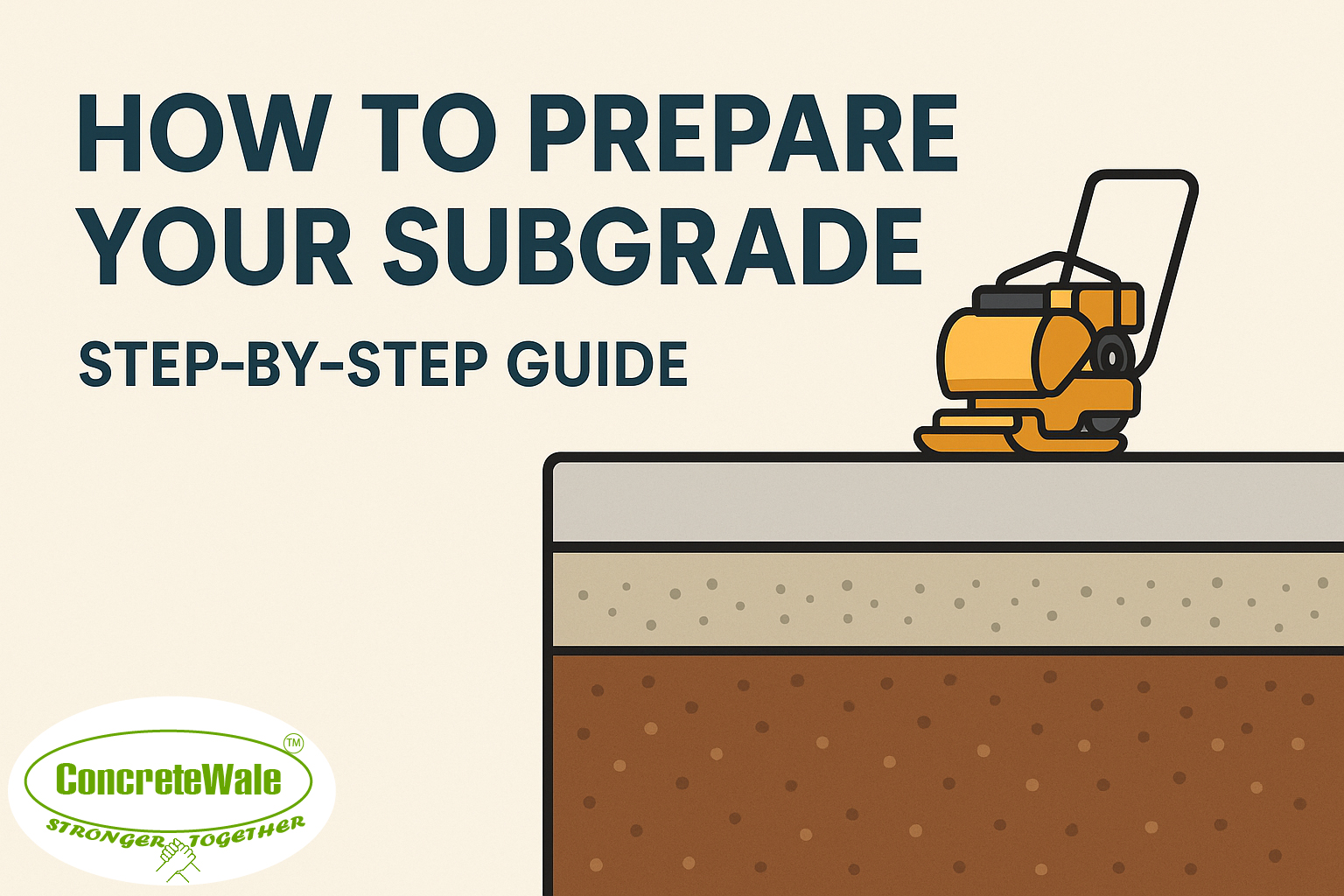
2. Excavate to the Correct Depth!
Cut the soil to the depth required for:
-
Subgrade.
-
Sub-base (if required)
-
Concrete slab thickness.
Ensure the depth is consistent across the entire area so that the slab on grade thickness remains uniform.
3. Identify the Soil Type!
The soil type influences compaction and stability.
Granular Soil (Sand, Gravel)
-
Easy to compact.
-
Drains well.
-
Good support for slabs.
Cohesive Soil (Clay, Silt)
Expansive Soil.
Knowing your soil helps you prepare it correctly.
4. Moisture Conditioning!
For maximum compaction, soil must be at the optimum moisture content:
-
If soil is too dry, sprinkle water uniformly.
-
If soil is too wet, aerate or let it dry before compaction.
Moisture control ensures dense and stable soil.
5. Compact the Soil !
Compaction is the most important part of subgrade preparation.
Use:
-
Plate compactor (small areas)
-
Jumping jack rammer (tight or confined areas)
-
Vibro roller (medium/large areas)
Goal:
Achieve around 95% Proctor density, a standard requirement for quality construction.
A properly compacted surface should have:
-
No soft spots.
-
No rutting.
-
No shifting under load.
6. Add Granular Sub-Base (If Required)
In many cases, a sub-base layer of crushed stone or compactible gravel is recommended.
Benefits:
-
Better load distribution.
-
Improved drainage.
-
Increased overall strength.
-
Reduced settlement issues.
Typical thickness: 100–200 mm depending on site conditions and load.
After spreading, the sub-base must also be compacted.
7. Level and Proof-Roll the Surface!
Once compacted, the surface should be tested for stability.
Proof-roll test:
Drive a heavy vehicle (like a loaded truck) over the area and check for:
-
Deflection.
-
Soft patches.
-
Surface movement.
-
Deep tire impressions.
Any weak areas must be reworked and re-compacted.
8. Final Grading!
Shape and smooth the compacted surface to:
-
Maintain the required slope for drainage.
-
Ensure uniform slab thickness.
-
Avoid water ponding below the concrete.
A well-graded subgrade supports better concrete performance.
9. Install Vapor Barrier (Optional, but Recommended Indoors)
For indoor floors, warehouses, or moisture-prone areas:
This reduces moisture movement into the slab and prevents cracking, curling, and flooring issues.
Subgrade preparation is the backbone of any concrete project. When the soil beneath your slab is properly cleared, leveled, moisture-conditioned, and compacted, the concrete above it performs significantly better. Whether you're building a driveway, pavement, warehouse floor, or residential slab, investing time in preparing your subgrade is the key to long-term durability.