
Welcome to the India’s first and only dedicated platform for concrete, concrete related products, equipments, man power & services etc. pan India online directory
Banner Image
Blog Banner

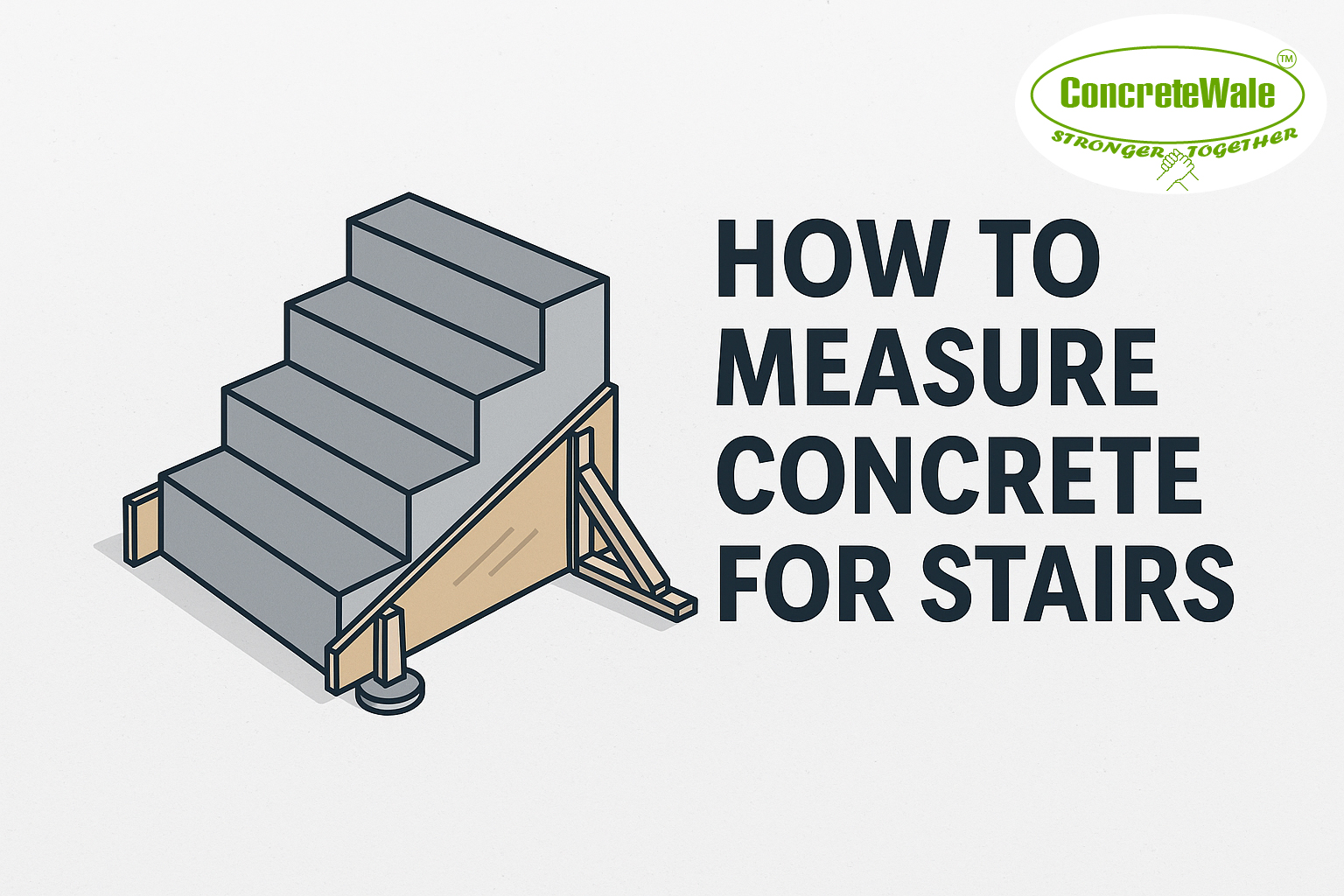
How to Measure Concrete for Stairs: A Complete Guide!

Concrete stairs are durable, safe, and long-lasting — but only if they’re poured with the right amount of material. Estimating concrete for stairs can seem confusing at first, because unlike slabs or columns, a staircase has multiple rises and treads that form a stepped shape.


Why Measuring Concrete for Stairs Matters ?

Ordering too little concrete stops your work midway. Ordering too much wastes money.
A staircase contains several triangular sections, so the most reliable way to estimate concrete is by calculating the volume of the steps and then adding a wastage margin.


Basic Terms You Need to Understand.

Before calculating, note these four measurements:

  • Tread (T): The horizontal part where you step.

  • Riser (R): The vertical height between one step and the next.

  • Step Width (W): Total width of the stairway.

  • Number of Steps (N): Total count of risers.

These values are enough to calculate concrete volume.


Step-by-Step Method to Measure Concrete for Stairs

Step 1: Measure Riser, Tread, Width & Number of Steps

Use a tape measure and confirm all steps are uniform.
For accurate calculations, convert all measurements to meters.

Example:

  • Riser = 150 mm = 0.15 m

  • Tread = 250 mm = 0.25 m

  • Width = 900 mm = 0.9 m

  • Steps = 6


Step 2: Calculate the Volume of One Step

Each step is essentially a triangular prism.

Formula:

Volume of One Step = (Riser × Tread × Width) ÷ 2

This formula works because the cross section of each step is a right-angle triangle.


Step 3: Multiply By Number of Steps

Total Step Volume = Volume of One Step × Number of Steps

This gives the combined concrete volume of all steps.


Step 4: Add Landing Volume (If Present)

If there is a landing:

Landing Volume = Length × Width × Thickness

Then add it to the stair volume.


Step 5: Add 5–10% Wastage

Construction always needs a little extra concrete to compensate for:

  • Formwork gaps

  • Surface leveling

  • Spillage

  • Compaction loss

A 10% margin is the safest.


Worked Example: Concrete for a 6-Step Staircase

Given:

  • Riser (R) = 0.15 m

  • Tread (T) = 0.25 m

  • Width (W) = 0.9 m

  • Steps (N) = 6

Step Volume

= (0.15 × 0.25 × 0.9) ÷ 2
= 0.016875 m³ per step

Total Stair Volume

= 0.016875 × 6
= 0.10125 m³

Add 10% Extra

= 0.10125 × 1.10
= 0.111 m³

  • Final Concrete Required ≈ 0.11 m³

This method works for almost all straight cast-in-situ concrete stairs.


Shortcut Formula (Quick Estimation)

If you want to estimate instantly:

Concrete (m³) = Number of Steps × Riser × Tread × Width ÷ 2

This gives a very close approximation.


Tips for Accurate Concrete Measurement

  • Always measure in meters for consistency.

  • Ensure all risers and treads are equal; uneven steps change the volume.

  • For heavy-duty stairs, check if extra thickness or waist slab depth is required.

  • Confirm if the design includes side walls, stringers, or landings — add their volume separately.


Subscribe For Update