
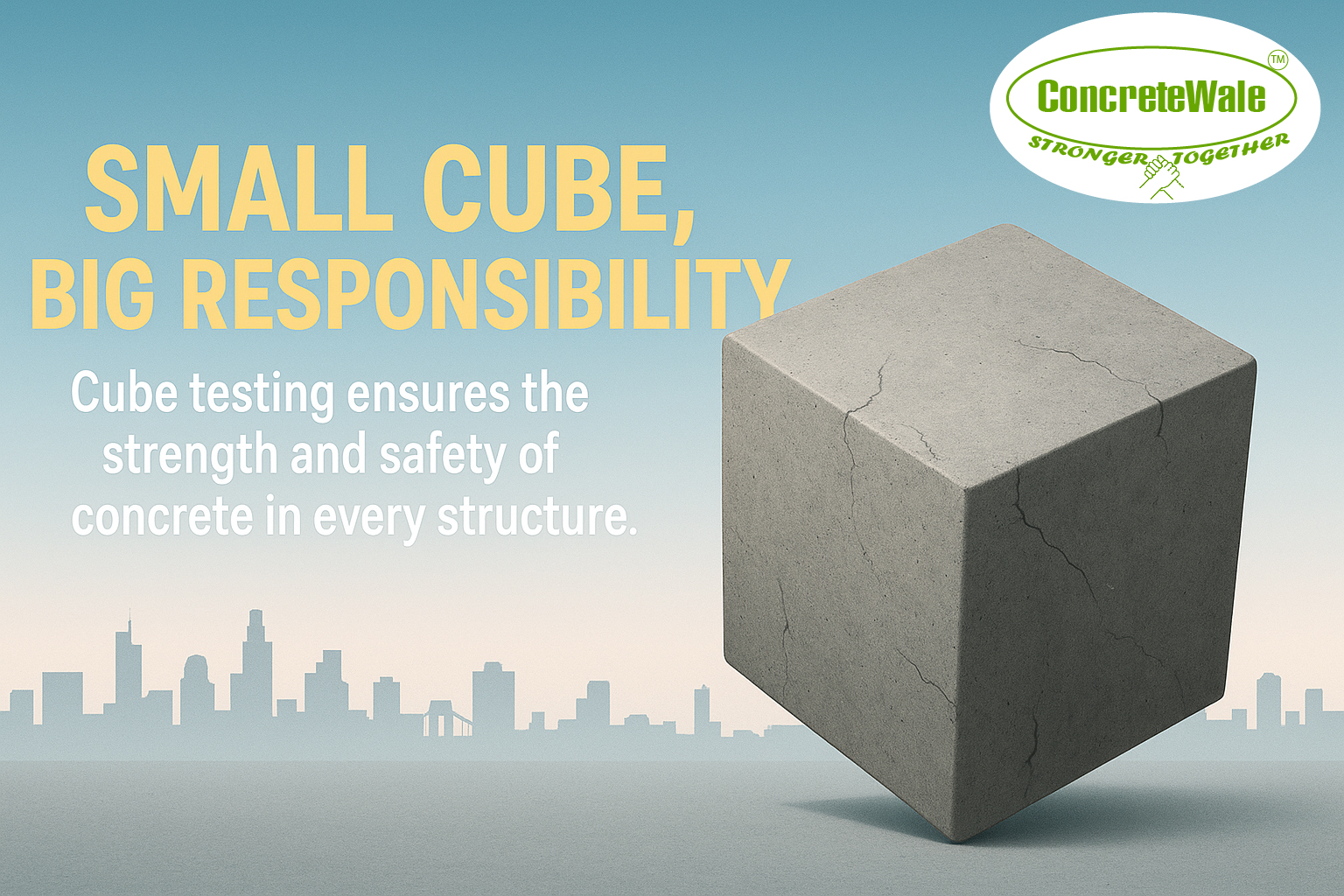
Cube Testing in Concrete: What It Is and Why It Matters
Understanding how cube tests ensure the strength and safety of concrete structures.
When we look at tall buildings, flyovers, bridges, or even our homes, they all rely on concrete. But how do engineers know if the concrete used is actually strong enough?
The answer is through a simple yet powerful method called Cube Testing.
Cube testing is the most common test used worldwide to check the compressive strength of concrete. In simple words, it tells us how much load the concrete can take before it breaks.
What is Cube Testing?
Cube testing is a process where a small sample of fresh concrete is poured into a cube-shaped mould (usually 150mm x 150mm x 150mm).
-
Once hardened, these cubes are taken to a laboratory.
-
They are tested under a Compression Testing Machine (CTM) to measure the amount of force they can handle before breaking.
This strength is then compared with the required design strength to confirm whether the concrete is good enough to be used in the structure.
How is Cube Testing Done?
Step 1: Preparation
-
Freshly mixed concrete is poured into cube moulds.
-
The mould is filled in 3 layers and each layer is compacted to remove air bubbles.
Step 2: Curing
-
After 24 hours, the cubes are removed from moulds.
-
They are kept in water tanks for curing at a temperature of about 27°C.
Step 3: Testing
-
Cubes are tested after 7 days and 28 days (sometimes 3 days too).
-
They are placed in a compression testing machine, and load is applied until the cube breaks.
-
The result is shown in N/mm² (Newton per square millimeter).
Typical Testing Ages and Their Purpose
-
7-Day Test: Gives an idea of early strength.
-
28-Day Test: Standard strength measure for concrete.
-
Later Ages (56/90 Days): For special concrete mixes like high-strength or blended cement concretes.
Acceptable Results
-
For example, an M25 grade concrete should achieve at least 25 N/mm² at 28 days.
-
If the result is lower, the structure may not be safe.
Factors That Affect Cube Strength
-
Quality of materials (cement, sand, aggregates, water).
-
Water-cement ratio.
-
Proper mixing.
-
Compaction of concrete.
-
Curing method and duration.
-
Handling and casting errors.
What If the Cube Fails?
-
Check for Errors: Sometimes failure is due to wrong testing methods or poor cube preparation.
-
Core Testing: Cylinders or cores can be taken from actual structure to check in-place strength.
-
Non-Destructive Tests: Methods like rebound hammer or ultrasonic pulse velocity (UPV) can help.
-
Remedial Actions: Strengthening or retrofitting methods are used if concrete is weaker than required.
Layman’s Example
Think of cube testing like checking the quality of a sample brick before using thousands of them in a house. If the sample fails, you won’t risk building the house with the rest. Similarly, if the cube test fails, you cannot trust the whole batch of concrete.
Cube testing may look simple, but it plays a life-saving role in construction. It is the easiest and most reliable way to ensure that the concrete used can bear the required load. From small houses to skyscrapers and bridges, cube tests are the backbone of quality control in concrete construction.
So, the next time you see a cube mould at a construction site, remember — it’s a small block that decides the safety of huge structures!