
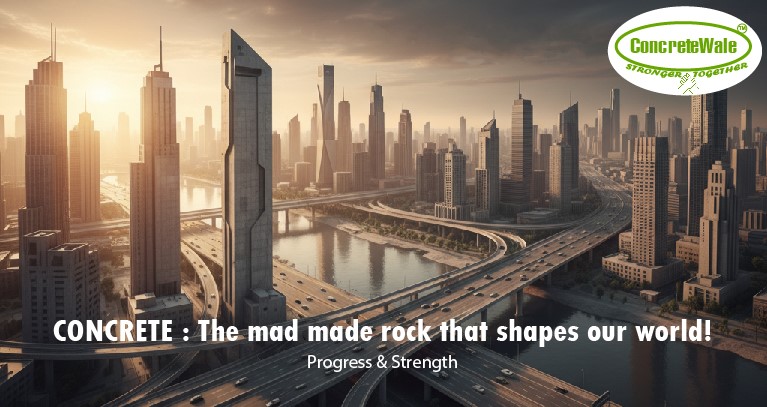
Concrete: The Man-Made Rock That Shapes Our World
When we think of rocks, we imagine something created by nature — formed deep within the Earth over millions of years. But there’s one rock that’s not natural at all — concrete. It’s a man-made rock that humans have engineered, shaped, and used to build the foundations of modern civilization. From the tallest skyscrapers to the longest bridges, concrete is literally what our world stands on.
What Exactly Is Concrete?
Concrete is a mixture of cement, sand, aggregates, and water. At first, it’s a soft, moldable paste that can be poured or cast into any shape. But as it hardens, a chemical process called hydration takes place, bonding the ingredients together into a solid, rock-like material.
This transformation — from a fluid to a durable stone — is what makes concrete truly unique. Unlike most materials, concrete can take the shape of anything before turning into something incredibly strong and long-lasting.
A Rock We Invented: A Brief History
The idea of artificial stone isn’t new. Humans have been experimenting with mixtures similar to concrete for thousands of years:
-
Ancient Romans used volcanic ash, lime, and water to make what we now call Roman concrete, which helped them build architectural marvels like the Pantheon and aqueducts that still stand today.
-
After the fall of Rome, this knowledge was lost for centuries, until modern concrete was reinvented in the 19th century with the development of Portland cement.
-
In the 20th century, reinforced concrete (with steel bars) revolutionized construction — making it possible to build skyscrapers, dams, tunnels, and massive bridges.
From ancient times to the modern era, concrete has been the backbone of human progress.
Why Concrete Is Stronger Than Many Natural Rocks
Concrete doesn’t just look like rock — it performs like one too. In fact, depending on its mix design, concrete can reach compressive strengths greater than granite.
Engineers can adjust its proportions to make it lighter, denser, more flexible, or even resistant to chemicals and extreme weather. It’s this adaptability that gives concrete its legendary strength and longevity.
The Power of Shape: Concrete Can Be Anything
One of concrete’s most fascinating traits is its versatility. Before it hardens, it can be cast into any form imaginable — smooth curves, complex textures, even artistic sculptures.
This property allows architects and engineers to create innovative designs such as:
-
Flowing architectural facades
-
Sculptural monuments and art installations
-
Intricate decorative floors and furniture
-
Entire buildings printed using 3D printed concrete technology
Concrete doesn’t just take shape — it creates it.
Modern Innovations: Reinventing the Man-Made Rock
Concrete technology continues to evolve at a fast pace. Some of the most exciting advancements include:
-
Self-healing concrete – uses bacteria or special polymers to automatically repair cracks.
-
Green concrete – made from recycled materials or low-carbon cements to reduce environmental impact.
-
3D printed concrete – allows entire homes and structures to be printed layer by layer, cutting waste and cost.
-
Ultra-high-performance concrete (UHPC) – stronger, denser, and more durable than ever before.
These innovations are redefining how we build — making concrete not just a material of the past, but a key to sustainable construction in the future.
Concrete in Our Everyday World
Everywhere you look — roads, homes, dams, airports, and even art pieces — concrete is present. It’s estimated that concrete is the second most used material on Earth after water.
From rural pathways to mega infrastructure, from decorative finishes to marine structures, concrete connects us all.
Concrete is more than a construction material — it’s a man-made rock that shaped human civilization.
Its ability to take any shape, adapt to any need, and last for generations makes it the most remarkable material ever created.
“We don’t just pour concrete — we shape the future.